Academic Rigor: Preparing Students to Be College and Career Ready

By Marcy Miller
Secondary School Counseling Specialist, grades 7-12
FCPS School Counseling Services Department
While educational pundits have long discussed the academic and navigational skills that students need to be college ready, a growing body of research shows that students, regardless of their post-secondary goals, will need additional training and education to secure employment in the present and future workforce.
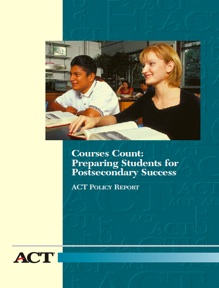
In fact, a 2005 study by ACT, entitled, Courses Count: Preparing Students for Postsecondary Success, indicates that 80 percent of today’s fastest-growing jobs will require some post-secondary education. Further, a 2010 study by Georgetown University’s Center on Education and the Workforce estimates that 62 percent of jobs in 2018 will require at least some college education.
It has become increasingly obvious that students need the same preparation to be college- or career-ready to be well-equipped for life after high school.
Consider the Evidence: In FCPS, we are focused on helping every student achieve success in college and in their careers. The question is, how are we going to accomplish this mission? We believe a good place to start begins with the recommendation from the 2004 report by the Pathways to College Network, A Shared Agenda: A Leadership Challenge to Improve College Access and Success.
Their recommendations include:
1. Improve access to and engagement in academic and personal counseling, college and career planning, and academic support
2. Provide ongoing assessment of progress and feedback for teachers, students, and parents using measurable outcomes of students’ academic progress.
3. Align academic instruction with skills required for success in first-year college courses without remediation
4. Integrate academic support with teaching and learning (including tutoring, supplemental instruction, learning communities, tailored developmental instruction, and study skills instruction)
School counselors can work closely with students and families to provide academic advisement and support the development of a plan to help students meet their post-secondary goals. Students should begin with the end in mind and understand how academic choices today affect their goals of tomorrow.
The Importance of Academic Rigor in College Admissions
Strength of the high school schedule is consistently ranked as the most important factor in college-admissions decisions. In addition to considering the coursework a student has completed in high school, colleges also use entrance exams scores to make admissions decisions.
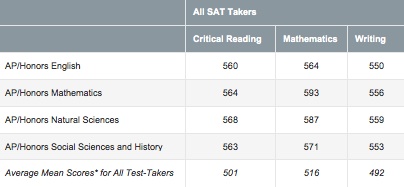
A recent College Board study showed that students in the class of 2010 who completed a core curriculum (four or more years of English, three or more years of mathematics, three or more years of natural science, and three or more years of social science and history) scored, on average, 151 points higher on the SAT than those who did not complete a core curriculum.
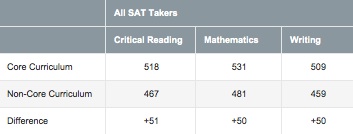
The College Board study also showed that in addition to completing core courses, students who completed AP coursework consistently scored well above the mean SAT score. Similar research studies have been conducted that examine the impact of International Baccalaureate (IB) coursework. A 2009 study conducted by David Conley on behalf of the Educational Policy Improvement Center concluded that students who learn the IB curriculum in high school gain the skills and knowledge to be academically successful in entry-level college courses.
The Bottom Line: Students who are encouraged to pursue rigor, and who push themselves just a little harder, achieve greater academic success. We believe that if we focus and strategize, just as we ask of our students, we can make all our students more successful.
About Marcy Miller: A secondary school counseling specialist with Fairfax County Public Schools, she previously served as the Director of Student Services at Fairfax High School, and as a school counselor at South County Secondary School and Westfield High School. Miller began her career in education with the Head Start program and has worked with students in every grade from Pre-K to 12. She is a graduate of James Madison University, holds an M.Ed. from the University of North Carolina at Chapel Hill, and earned her administrative endorsement through Lead Fairfax in collaboration with the University of Virginia. Contact her at: mgmiller@fcps.edu.