Is the Rigor of U.S. College and Career Readiness Standards Internationally Competitive?
By Teddi Predaris
Director of the Office of Language Acquisition and Title I
FCPS Instructional Services Department
The United States is facing dramatic challenges to its economic stature as the world becomes even more competitive in the coming years.
Because the jobs in today’s global economy continue to require higher levels of skill, upon graduation our students will be required to become even more productive and innovative.
Are we preparing our students to be successfully competitive in this global economy?
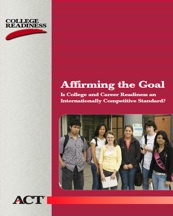
Consider the 2011 report, Affirming the Goal: Is College and Career Readiness an Internationally Competitive Standard? published by American College Testing, Inc. (ACT), which states that, “[new] performance standards of U.S. college and career readiness in reading and mathematics are internationally competitive.”
Preparing students with college and career readiness skills so that they can earn a college degree is one way that American students will be better prepared to be successful in the world they will inherit.
However, currently only 57 percent of U.S. college freshmen graduate from college—a rate that is below that of many other nations including Japan at 93 percent, Russia at 80 percent, Slovenia at 64 percent, and Mexico at 58 percent.
ACT research shows that college readiness is directly correlated to college completion. However, of the 1.5 million 2010 high school graduates who took the ACT test, only 24 percent met the College Readiness Benchmarks in English, mathematics, reading, and science. This tells us that fewer than 1 in 4 high school graduates were ready for college without needing remediation.
The new Common Core Standards Initiative, which aligns U.S. K-12 education with college and career readiness, was created to better prepare students for postsecondary needs. Recent results show that the new U.S. standards are, in fact, competitive internationally.
Also, Virginia has recently done an alignment study with the Common Core Standards and has found that the new Virginia Standards of Learning in reading and math are at or above the level of rigor of those of the Common Core.
The FCPS Program of Studies (POS) includes the new Virginia Standards of Learning.
Specifically, some examples of these new college- and career-readiness standards include:
1. Integrate multiple sources of information presented in diverse formats and media (e.g., visually, quantitatively, orally) in order to make informed decisions and solve problems, evaluating the credibility and accuracy of each source and noting any discrepancies among the data.
2. Respond thoughtfully to diverse perspectives; synthesize comments, claims, and evidence made on all sides of an issue; resolve contradictions when possible; and determine what additional information or research is required to deepen the investigation or complete the task.
If we prepare our students with mastery of these types of 21st century college- and career-readiness skills, I am confident that our students can be successful in this global economy and that we can improve the future long-term economic viability of the United States.
About Teddi Predaris
Teddi Predaris is director of the Office of Language Acquisition and Title I, Instructional Services, in Fairfax County Public Schools (FCPS). Predaris previously served as director, coordinator, and specialist of ESOL services in FCPS. Prior to her tenure as an administrator in Fairfax, she was the assistant director of the national information center on ELL student education, the National Clearinghouse for English Language Acquisition (formerly NCBE).
She has also served as a professional development and resource specialist at multistate regional education resource centers, providing technical assistance and training to school districts on ELL student education. She has taught ESOL and World Languages in the United States and abroad and holds a B.A. from Duke University, an M.S. from Georgetown University, and an M.A. from Middlebury College.
For more information, or to talk about rigor, send her an email at TGPredaris@fcps.edu.