5. Elementary Mathematics Instructional Sequence
This project is designed to implement the new 2009 Virginia Department of Education (VDOE) mathematics Standards of Learning (SOL) and to revise the current Fairfax County Public Schools (FCPS) elementary instructional sequence including advanced mathematics.
These revisions will provide access to advanced mathematics for all students and ensure rigor in our mathematics instructional program.
FCPS is committed to students achieving their full academic potential in mathematics. Our measures include students enrolled in courses beyond Algebra 2 to include Advanced Placement (AP) and International Baccalaureate (IB) courses in Statistics and Calculus.
Research indicates that students who access Algebra 1 by grade 8 have more opportunities for advanced mathematics and science coursework in preparation for college and career readiness.
To reach these goals, students need a strong foundation in mathematics concepts at all levels in elementary school, and teachers need the tools to teach these concepts at a deeper conceptual level.
Current status
Currently Fairfax County elementary schools provide a grade-level mathematics curriculum, and an advanced mathematics curriculum (compacted) for selected students in grades 3 through 6.
Starting in fall 2011, the current compacted mathematics course will be renamed Advanced Mathematics. Changes in the elementary mathematics instructional sequence will provide greater access for all students to receive more rigorous instruction.
The new elementary mathematics instructional sequence and Advanced Mathematics will provide opportunities for students who are ready to access advanced mathematics instruction from kindergarten to 6th grade. Students can access the new curriculum at any grade level or even within specific strands of mathematical concepts.
During summer 2010, the mathematics office staff met with schools not offering grade 6 compacted mathematics to provide them with the resources (blended documents and school support) needed to offer the compacted mathematics curriculum through differentiation for 2010-2011. The curriculum is now being offered at nearly all of our elementary schools, including three middle schools that have grade 6.
Extensive professional development is needed to train 3,500 Kindergarten through grade 6 (K-6) elementary teachers to deepen their understanding of mathematics content, pedagogy, and methods.
Classroom teachers will need to be ready to implement the new standards and instructional sequences in August 2011.
Challenges
The challenge of training this large number of teachers in a short amount of time requires extensive human and fiscal resources.
The current professional development plan includes face-to-face and online teacher training to be facilitated by teacher leaders who will then provide staggered turnaround training in their schools.
Specifically, the February 1, 2011, in-service day training was an expansive one, laying the foundation for the new instructional sequence. Therefore, each elementary school was required to send one teacher from each grade level to that training.
The mathematics office staff is working on an eLEARN IT course as another method of delivering professional development.
Funding information:
Funding for the project includes $33,900 allocated from the ISD budget for hourly teacher assistance to support all the extensions that will be updated in the math eCART item bank ($20,000, along with $13,900 for best practices materials).
Possible sources of funding include PMOC, mid-year budget adjustments, or reallocation of funds from another ISD project.
Ideally, additional funding, if provided, would allow for expanding the existing professional development plan to provide summer training for 120 teachers.
These teachers will provide systemic cluster turnaround training and support during the 2011-2012 school year.
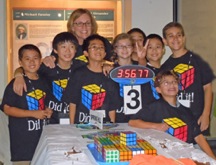
Photo: The Rubik’s Cube team from Spring Hill Elementary School finished second in the You Can Do the Cube competition, part of the USA Science and Engineering Festival. Image by www.fcps.edu